;)
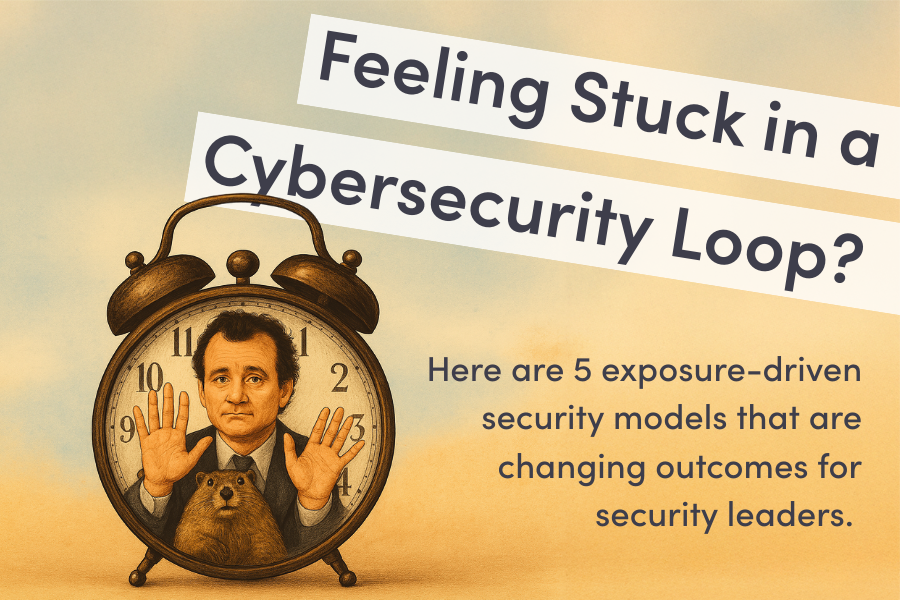
Most security leaders don’t describe their biggest challenge as a lack of tools or data. They describe it as a sense of repetition. As a CISO and security operator, I’ve felt it too.
- The same exposures show up quarter after quarter.
- The same risks get deferred for operational reasons.
- The low-criticality signals are ignored in favor of higher-criticality signals (big mistake today).
- The same incidents look familiar, even when the technology stack has changed.
That feeling is often joked about internally, but it reflects a real structural problem in how many security programs operate today. They are good at identifying issues, but not always good at eliminating the conditions that cause those issues to resurface.
There’s a reason the movie Groundhog Day still resonates decades later. It isn’t about repetition itself. It’s about what happens when nothing fundamentally changes.
For security leaders, the question isn’t how to work harder inside the loop.
It’s how to redesign the loop altogether. Here are five practical lessons modern security programs are learning. These lessons map directly to how exposure-driven models like CTEM and Quisitive’s Spyglass services are changing outcomes.
1. Repeated findings are a signal, not a failure
When the same identity gaps, misconfigurations, or cloud exposures keep reappearing, the instinct is often to push remediation harder. But repetition usually points to a systemic issue, not a performance issue.
Common root causes include:
- Unclear ownership across identity, cloud, and application teams
- Controls that exist but are inconsistently enforced
- Remediation workflows that don’t align with how IT actually operates
- Security metrics that reward activity instead of reduction
Exposure-based programs treat recurrence as diagnostic data. If something keeps coming back, the question becomes: what structural change removes it permanently?
That shift alone can dramatically reduce noise and burnout.
2. Security maturity isn’t about seeing more, it’s about deciding better
Most enterprises already have strong visibility. They know what’s vulnerable. They know where configurations drift. They know which identities are over-privileged.
The hard part is deciding what actually matters now.
Research consistently shows that attackers exploit a narrow subset of exposures that are reachable, chainable, and tied to high-value assets. Yet many programs still prioritize based on severity scores or scan volume.
Modern exposure management flips this:
- Prioritize by exploitability and business impact
- Validate attack paths instead of assuming risk
- Focus on reducing likelihood, not just documenting issues
That’s how security teams move from being busy to being effective.
3. AI has made “event-based security” obsolete
AI has quietly changed the security equation.
- It accelerates how attackers operate.
- It increases configuration complexity.
- It introduces new access paths through APIs, models, and data pipelines.
At the same time, many organizations are still treating AI risk as a future problem or a policy discussion.
The reality is that AI expands the attack surface in ways that don’t fit cleanly into traditional vulnerability management. Shadow AI usage, excessive access to models, insecure integrations, and data leakage through prompts all create exposure that isn’t captured by point-in-time assessments.
Continuous exposure management works because it adapts as the environment changes. It doesn’t assume stability. It assumes movement.
4. The best security programs optimize for removal, not response
Response will always matter. But the most mature programs are shifting investment upstream.
They focus on:
- Shrinking the number of viable attack paths
- Hardening identity and access at scale
- Reducing externally reachable surfaces
- Fixing classes of issues instead of individual findings
This is where managed services become valuable, not as outsourced alert handling, but as operational pressure applied consistently over time.
Quisitive’s Spyglass model is built around that principle: continuous vigilance and validation, measured remediation, continual posture improvement, reduction, and optimized efficiency, not episodic cleanups.
The outcome is fewer surprises and fewer repeat conversations.
5. Boards don’t want certainty. They want trajectory.
Security leaders are often asked to provide certainty in an uncertain domain. That’s unrealistic.
What boards actually want to see is:
- Clarity on what would hurt the business most
- Evidence that those risks are shrinking
- Confidence that security investments are aligned to outcomes
Exposure-driven programs support that narrative because they produce trendlines. Not just reports, but proof that the organization is moving in the right direction.
That’s how security becomes a business conversation instead of a technical one.
Breaking the cycle
The reason so many security leaders feel stuck isn’t that they’re failing. It’s because the operating model they inherited was designed for a simpler attack surface.
Cloud, SaaS, identity sprawl, and AI have changed that reality. Programs that don’t evolve end up reliving the same challenges under new names.
The way forward isn’t perfection. It’s continuous improvement with intent.
That’s what CTEM enables. And it’s why more enterprises are treating exposure management as a core security discipline, not a side project.
Join the conversation on February 26
If this resonates, we’re hosting a practical session for security leaders who want to move beyond recurring risk conversations:
Register now: How Security Leaders Are Rethinking Risks in an AI-Driven World in 2026
February 26, 2026
Till next time,
Ed
CISSP, CISA, CISM, CGEIT