What SharePoint’s zero-day crisis reveals about our collective blind spots.
Two vulnerabilities: CVE-2025-49706 (spoofing) and CVE-2025-49704 (remote code execution) were disclosed on July 19 by Microsoft’s Security Response Center (MSRC). Both had been under active exploitation before that disclosure, targeting environments still reliant on legacy SharePoint infrastructure.
But the real shocker came days later: CVE202553770, dubbed “ToolShell,” emerged as an unpatched zero-day that had already achieved persistence in sensitive U.S. government systems (e.g., on-premises servers)
This wasn’t just another breach. It was a moment of reckoning for organizations clinging to outdated systems while modern threat actors evolve faster than we patch.
It’s important to note that these did not impact SharePoint Online in Microsoft 365.
Microsoft issued emergency updates for SharePoint Server Subscription Edition, 2019, and 2016.
Inside the Attack: What We Know
Initial signs of compromise surfaced around July 18, when defenders identified malicious ASPX web shells being dropped onto vulnerable SharePoint servers. From there, attackers moved quickly stealing cryptographic machine keys, establishing footholds, and exploiting authentication trust to pivot deeper into victim networks
Despite a previously released patch cycle on July 8 (unrelated to ToolShell), attackers exploited known weaknesses and bypassed mitigation layers. Microsoft responded with a new round of emergency patches by July 20 to stop the bleeding.
Let’s be clear: these were well-resourced adversaries likely leveraging automation to scan for unpatched or publicly exposed SharePoint instances, many of which were still running SharePoint 2016 or 2019. In some cases, these platforms haven’t seen a meaningful update in years. A fact that we, as security leaders, must acknowledge and we must own that.
Why SharePoint Online Was Unaffected (And Why That Matters)
There’s a reason SharePoint Online emerged unscathed: Microsoft’s cloud infrastructure was built for resilience.
Resilience is a descriptor I have been using a lot this past year. For example, at a recent healthcare conference keynote that I delivered, I challenged the narrative of “Are we Compliant” with “Are we Ready” to promote the concepts of Resilience with broader audiences than IT and Security subject experts, but businesspeople.
“Security is not a destination, but it’s not really a journey either. Security is a discipline and one that survives on Resilience”.
But that’s for another day.
The Bigger Problem Isn’t the Breach – It’s the Inertia
If you’re reading this and still managing SharePoint Server 2016 or 2019, ask yourself: Why?
We’ve all heard the excuses:
“We’ve always done it this way.” “We’re not ready for the cloud.” “We’ll get to it next quarter.”
But, inertia is not a strategy. It’s a liability.
It’s not about the cloud being perfect. It’s about your ability to detect, contain, and recover from the breach before your organization makes the evening news. And increasingly, cloud-based platforms with layered telemetry, always-on SOCs, and policy-driven access are simply better equipped for that job.
When security researchers identify a zero-day, Microsoft can rapidly deploy mitigations and patches across tenants instantly without waiting on a systems admin to read a blog post or navigate patching politics. That’s the beauty and significant cost savings associated with moving to the Cloud.
Cloud services like Microsoft 365 also operate within an opaquer threat surface:
No direct internet exposure of critical backend systems
Layered defense with real-time analytics from Defender
Managed identity planes and privileged access boundaries
On-prem environments, by contrast, often lack visibility, automation, and staff capacity to implement Zero Trust at scale. In fact, many are still configured with flat networks, persistent admin credentials, and legacy authentication protocols that attackers love.
This incident simply re-underscores the urgency of deploying modern cybersecurity strategies, particularly the move to cloud infrastructure and the adoption of managed security services.
The Role of Managed Security Services Providers in a Post-Zero-Day World
Even with cloud security, proactive and responsive security strategies from MSSPs add vital layers of defense for detection, prevention, and response. Most companies find that the cost of employing all of the necessary security roles to manage security is cost prohibitive, making MSSPs a critical partner in the fight against security threats.
These strategies fall into two key areas which are both critical areas where Quisitive’s Spyglass Security & Compliance Services team shines.
Preemptive Security
Proper configuration of cloud services (MFA, encryption, least privilege)
Continuous vulnerability scanning and security posture assessments
Integration of threat intelligence feeds from Microsoft, Security Researchers, CISA, and partners like Quisitive
Regular employee cybersecurity awareness training
Responsive Security
24/7 monitoring for anomalies and alerts
Threat hunting and forensic incident analysis
Immediate containment and remediation protocols
Security roadmap iteration, post-breach or not
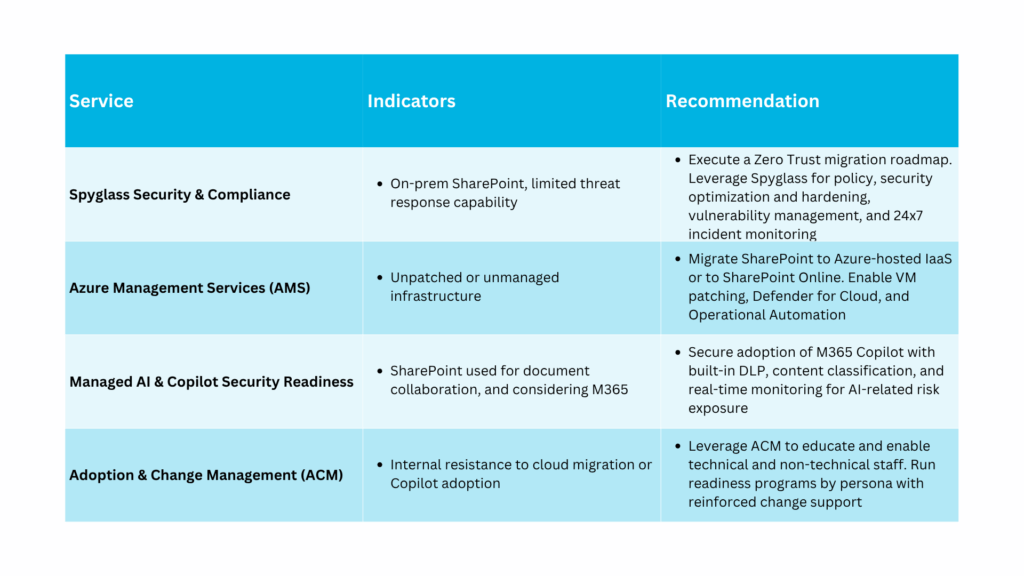
How Quisitive Can Help? Our Complete Security Services That Address the Root Cause
Final Thoughts
This was not a wake-up call. It was a fire alarm.
It exposed a simple truth: the organizations that were least impacted were the ones who had already made the decision to modernize not just with technology, but with operational readiness. If you’re maintaining legacy systems because “it still works,” just remember it works until it doesn’t.
If you’re ready to future-proof your collaboration platforms and implement a true Zero Trust architecture with Microsoft 365, let’s talk. Quisitive and our Spyglass team can deliver risk-aware modernization strategies that are actionable, resilient and compliant, and backed by real-world results.
Till next time,
Ed
Cloud security and compliance made easy with Quisitive
At Quisitive, we understand that every organization, regardless of industry or vertical needs to maintain a secure environment, on-premises or in the cloud.
Quisitive provides IT security and compliance solutions and services that build, improve, and maintain your organization’s secure environment.

;)