;)

Security teams are exhausted. Many CISOs are watching skilled analysts burn out, turnover rise, and vacancies remain unfilled for months. At the same time, Microsoft security investments are expanding. Azure, Defender XDR, Sentinel, Entra, and Purview are producing more security signals than ever, and without the right tuning and capacity, the noise becomes overwhelming.
This isn’t a tooling problem. It’s a human and operational resilience problem that directly affects risk, cost, and your ability to protect the business.
The Human Toll of Alert Fatigue
According to ACM’s “Alert Fatigue in Security Operations Centres”, security professionals are being overwhelmed by alert volume, with only half of alerts consistently investigated. This drives stress, burnout, and missed critical signals.
The workforce challenge is circulating and increasingly being talked about. ICS2’s Cybersecurity Study reports that the global cybersecurity talent gap remains at over 4 million unfilled roles, and retention is now a greater threat than hiring.
For CISOs, this means internal SOC teams are stretched thin before new Microsoft workloads like Copilot, Security Copilot, and expanded Defender integrations even enter the picture.
Why Microsoft-Centered Environments Feel It More
Microsoft has consolidated security signals into fewer panes of glass, which is a strategically sound move. But consolidation does not mean less volume.
Three realities make alert fatigue particularly acute for Microsoft shops:
1. Consolidation increases visibility and volume.
Defender XDR correlates alerts across M365, identity, devices, endpoints, and apps. Sentinel ingests even more from Azure, hybrid infra, and third-party sources. Without tuning, the incident queue grows faster than analysts can respond. And while consolidation is key, volume gives tons of context that you don’t want to ignore. The key here is to eliminate false positives, which your teams are chasing, and which are the cause of burnout.
2. New security capabilities introduce new signals.
Microsoft continues to add detections across Defender, Entra, Intune, and Sentinel. Valuable? Yes. But defaults often trigger more informational or duplicative alerts if teams don’t adjust rule logic and thresholds. Feeding this context into your analytics engine and SOAR processes is mandatory.
3. Identity complexity expands the attack surface.
As organizations adopt Entra ID Conditional Access, multi-cloud identity, and app integrations, misconfigurations generate operational alerts that drain time. Early adopters of Security Copilot report meaningful reductions in triage time for identity and device policy conflicts.
The result: More alerts, more signals, more places threats can hide.
The Cost of Trying to Manage This Internally
The instinct for many CISOs is to “staff up” or “tune more rules”, but that often leads to higher spend with limited improvement.
Here’s the economic reality:
A 24×7 internal SOC requires 8 to 12 FTEs, including analysts, incident responders, engineers, and a SOC lead. With average enterprise security talent costing USD $150K–$190K per person, CISOs are looking at USD $1.5M–$2.2M per year, before tools, training, and turnover.
Meanwhile, the cost of a breach continues to rise, hitting USD $4.88M on average in 2025. Source: IBM & Ponemon Cost of a Data Breach Report, 2025
Simply “adding more people” is not a scalable solution.
The Hidden Cost: Missed Risk Reduction Work
When teams spend most of their energy clearing noise, the strategic work that actually reduces risk slips:
- Identity hardening and privileged access cleanup
- Automation engineering and SOAR maturity
- Threat hunting and proactive detection use case development
- Data governance and insider risk programs
This creates a false sense of coverage: a busy SOC is not always an effective one.
Microsoft Gives You Tools to Reduce Noise – If You Have Time to Use Them
Microsoft provides documented ways to cut noise and reclaim analyst capacity:
- Defender XDR correlation and incident merging to reduce duplicate alerts
- Sentinel automation and playbooks to auto-triage routine events
- Azure Monitor dynamic thresholds and processing rules to suppress non-actionable alerts
The issue is not capability. It is capacity. Most internal teams don’t have the bandwidth to operationalize all of this consistently.
Why CISOs Are Shifting to a Managed or Hybrid SOC Model
This isn’t about outsourcing responsibility. It’s about structuring SecOps for resilience and outcomes.
A strong managed security model delivers:
1. Lower cost per alert and faster triage.
Automation, correlation, and Copilot-assisted triage reduce the volume of alerts that need human review. Use that abundant context to help SOAR, analytics, triage process, and AI to work more effectively
2. 24×7 coverage without burnout.
Internal teams focus on engineering, prevention, and business-aligned security work.
3. Continuous tuning and modernization.
A partner stays current on Microsoft updates, so your environment stays optimized.
For most enterprises, the cost of a managed partner is a fraction of the fully burdened internal model, especially when considering burnout and turnover costs.
What to Ask a Managed Security Partner Before You Engage
To ensure you’re not just “lifting and shifting the problem,” ask:
- How do you tune Defender XDR and Sentinel to reduce alert volume within the first 30 days?
- What automation and playbooks will you implement immediately, and what metrics will you report weekly?
- How do you eliminate 99% of true false positives so that my people can focus on what’s real and chase that?
- How do you integrate Security Copilot into triage and investigations to reduce time to respond?
- How do you support a hybrid model so internal teams continue to grow and stay empowered?
The Bottom Line
Alert fatigue is not just a nuisance; it is a risk amplifier. Microsoft provides the tools to reduce it, but most internal teams no longer have the capacity to implement and sustain them without trade-offs.
A managed or hybrid model allows your team to focus where they create the most value, while a trusted Microsoft security partner helps you stay ahead of threats, noise, and burnout.
Quiet the Noise and Take the Pressure Off Your Security Team with Spyglass
If your analysts are fighting alert fatigue in Microsoft security tools, you don’t need to tackle it alone. Spyglass, Quisitive’s Microsoft-focused Managed IT Security Services program, helps reduce noise, strengthen defenses, and restore capacity to your team.
Spyglass is built for organizations running on Microsoft. We combine proactive security posture management with continuous monitoring, identity hardening, and real-time response to help you prevent issues before they escalate.
With Spyglass, you get:
- A 24×7 Microsoft-aligned security program without hiring 8, 12, or many more full-time SOC experts
- Proactive tuning and optimization across Azure, Entra, Defender, Sentinel, and Microsoft 365, as well as your non-Microsoft security tools (they are relevant too)
- Expert security advisors who work alongside your team, not around them
• Better use of the Microsoft technology you already own – no rip-and-replace, no extra tools
If you need around-the-clock threat monitoring and rapid response, Spyglass MDR adds dedicated defenders and threat hunters to stop attacks before they cause damage.
Spyglass gives CISOs the confidence that daily security is under control, so internal teams can focus on higher-value work like automation, AI-driven SecOps, identity strategy, and long-term risk reduction.
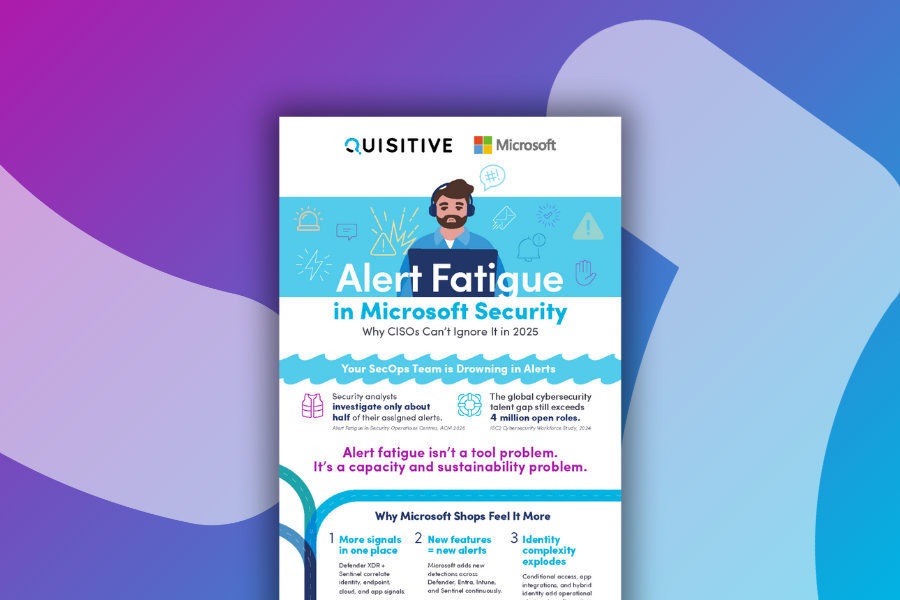
Get the infographic
Alert fatigue is overwhelming SecOps teams and increasing business risk. Explore effective solutions for minimizing the noise in our full infographic!
Ready to ease the pressure on your security team?
Your team shouldn’t have to choose between survival mode and security maturity. With Spyglass, you can have both.