;)
Disruption and opportunity are colliding across industries. Global growth is slowing. Uncertainty is rising. Tariffs are increasing supply chain costs. Inflation is squeezing margins.
At the same time, AI is reshaping how businesses operate, not just automating tasks but enabling smarter, faster decisions. The organizations that thrive will be those that use AI to predict disruption, not simply react to it.
How Finance and Operations Teams Are Struggling
Among finance and operations leaders, one theme is consistent: teams are stretched, systems are fragmented, and organizations struggle to move at the speed required.
- 64% of people struggle with having the time and energy to do their job (Microsoft Work Trend Index, 2023)
- Only half of organizations feel prepared to anticipate and react to external shocks, and two-thirds say their organizations are overly complex and inefficient. (McKinsey State of Organizations, 2023)
CFOs and COOs frequently share that this complexity keeps them in reactive mode, lacking the real-time visibility needed to steer performance proactively.
Why ERP Systems Are Shifting from Generative AI to Agentic AI
Most people understand generative AI as something that can draft, summarize, or answer questions. Agentic AI goes a step further.
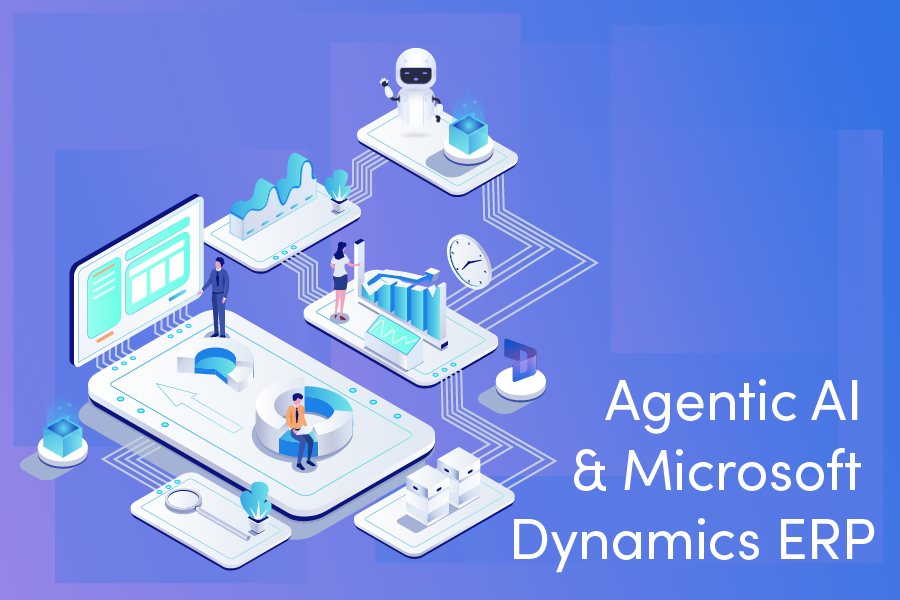
Agentic AI is AI systems that can reason, plan, and act to complete work across tools and processes. That doesn’t mean humans disappear from the process. It means organizations can build hybrid workflows in which humans focus on judgment and outcomes while agents handle repeatable decisions and execution steps.
This shift is already being predicted at scale:
- Gartner predicts that by 2028, 15% of day-to-day work decisions will be made autonomously through agentic AI. (Gartner press release, June 25, 2025)
AI won’t just assist work; it will increasingly drive portions of work, with appropriate guardrails and oversight.
The Rise of Frontier Teams: Humans + Agents Working Side-by-Side
As AI agents become more capable, the blueprint for high-performing organizations is shifting.
Microsoft’s Work Trend Index describes the emergence of a ‘Frontier’ model built around on-demand intelligence and hybrid teams of humans plus agents.
Key indicators from that research include:
- 81% of leaders expect agents to be moderately or extensively integrated into their company’s AI strategy in the next 12–18 months. (Microsoft Work Trend Index 2025)
Frontier teams combine human expertise with AI agents, enabling organizations to scale capacity without scaling headcount. Instead of chasing hype, the goal is to understand what these tools make possible: faster execution, greater agility, and a shorter gap between insight and action.
The Biggest Barrier: Siloed Data and Legacy Systems
The current challenge is that AI depends on access to data, workflows, and the ability to act across systems.
But many organizations still run critical processes on fragmented, legacy platforms that weren’t designed for real-time intelligence or cross-functional orchestration. That’s one reason leaders cite complexity and inefficiency so often, because disconnected systems create disconnected work.
Dynamics 365: A Modern ERP Built for AI
Dynamics 365 provides a cloud-based ERP foundation that unifies finance and supply chain operations, reduces system fragmentation, and delivers real-time visibility across the business.
A Forrester Total Economic Impact™ (TEI) study found that organizations using Dynamics 365 improved efficiency and decision-making by centralizing data and standardizing processes (Forrester TEI, 2024).
- 106% ROI over three years (Forrester TEI, 2024).
- 17-month payback period and $8.10M net present value (NPV) (Forrester TEI Infographic, 2024).
These outcomes highlight how a modern ERP like Dynamics 365 can support AI-driven operations by improving data quality, consistency, and operational agility.
What Agentic ERP Can Offer
When the ERP foundation is modern and connected, agentic capabilities can move from idea to reality. In day-to-day terms, that can look like:
- Faster planning cycles because data is unified and current
- Fewer manual handoffs between finance and operations
- Earlier risk detection through real-time visibility
- More consistent compliance workflows through automation
These aren’t just technology upgrades; they’re capacity upgrades.
How Quisitive Helps You Get the Most Out of Dynamics 365
Modernizing an ERP is a big move – here’s how we help:
- Deep Dynamics 365 expertise – We understand the platform end-to-end across finance, supply chain, HR, and commerce.
- Integration excellence – We connect Dynamics 365 with the systems you still need, so your ERP doesn’t become another silo.
- Industry-informed strategies – We shape the rollout around your business reality, not a generic template.
- Ongoing support and training – We help teams adopt confidently and keep improving after go-live.
Ready to Modernize Your ERP System?
If your organization is preparing for ERP modernization or exploring AI-enabled operations, Quisitive can help. We support Dynamics 365 implementations, integrations, and ongoing management so you can build a future-ready, agentic foundation.