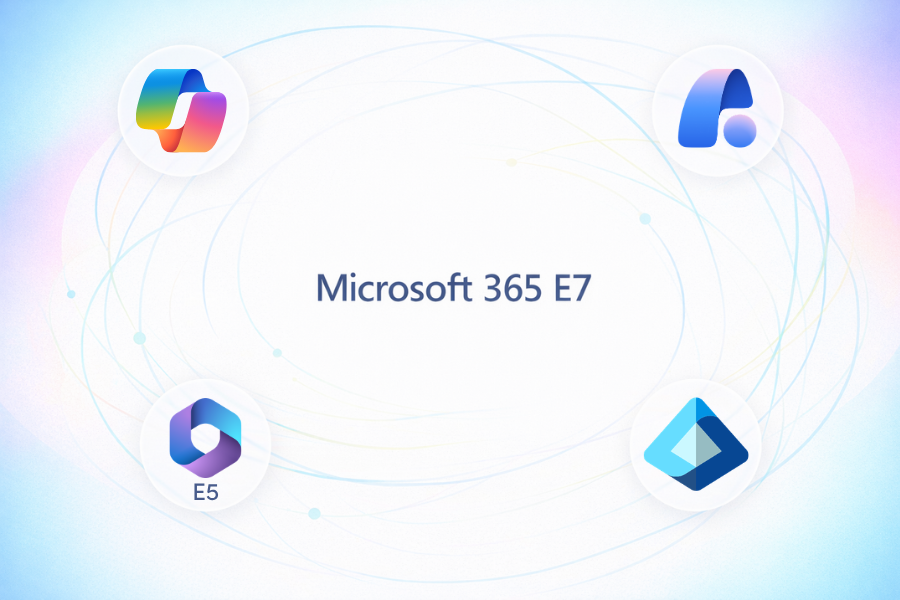
Microsoft 365 E7 is officially here, the first new enterprise license tier since E5 launched in 2015. It bundles Microsoft 365 E5, Microsoft 365 Copilot, the Entra Suite, and Agent 365 into a single governed platform at approximately 15% below the cost of purchasing the components separately. It became generally available on May 1, 2026.
For CIOs and CISOs, the strategic question is not whether E7 is a good product. It is whether your current AI posture – the agents running in your tenant, your identity controls, your governance framework – is built to control what is already happening in your organization. The answer, for most enterprises, is no.
What Is Microsoft 365 E7?
Microsoft 365 E7, branded the ‘Frontier Suite,’ is the productivity infrastructure for a human-led, agent-operated enterprise. It is not a feature upgrade but instead a new operating model for AI works across an organization: embedded in daily tools, grounded in organizational context, and governed with the same rigor as users and data.
E7 combines four components:
| Component | What It Delivers |
|---|---|
| Microsoft 365 E5 | Full productivity, Defender, Purview, Intune, and identity controls – the E5 security foundation extended for AI |
| Entra Suite | Zero Trust network access, identity governance, identity protection, and verified ID securing every human and agent identity across the tenant |
| Microsoft 365 Copilot (Wave 3) | AI embedded in Word, Excel, PowerPoint, Outlook, and Teams. Agentic execution. Multi-model routing. |
| Microsoft Agent 365 | Registry, observability, identity governance, and policy enforcement for every AI agent across the tenant |
| Microsoft 365 E7 Bundle | All four components. One SKU. One governed platform. |
Source: Microsoft Partner FAQ, April 2026; Microsoft Official Blog, March 9, 2026
Microsoft 365 E7 vs. E5: What Actually Changed?
This is the question every CIO will be asked by their CFO. The direct answer: E5 gives you the security and productivity foundation. E7 adds Copilot, Agent 365, and the Entra Suite, making AI, agentics and AI governance native in your environment, not an add-on.
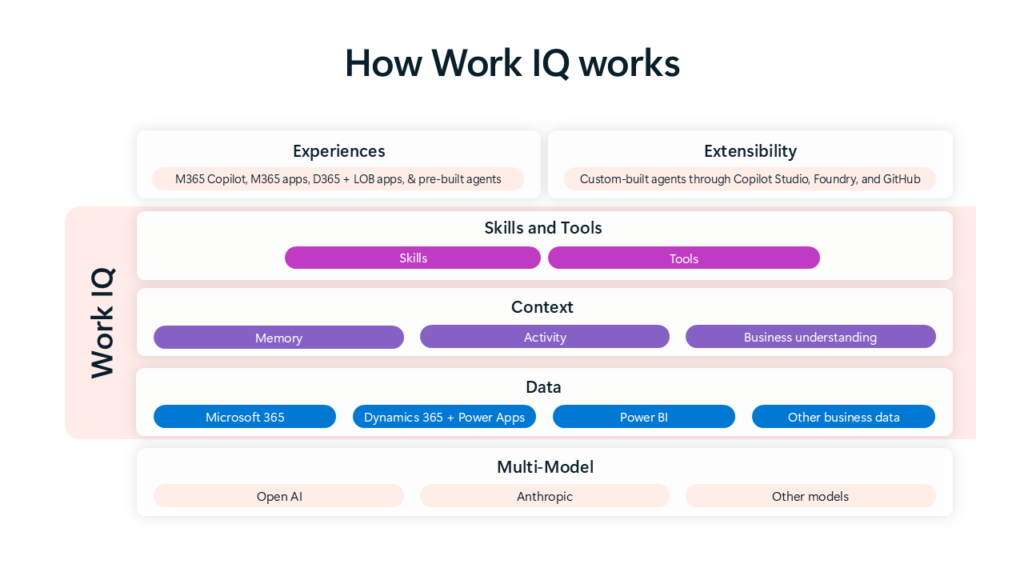
The meaningful architectural shift in E7 is not the addition of features, it is the introduction of Agent 365 as the control plane for AI agents, and Work IQ as the shared intelligence layer that connects Copilot and agents to organizational context.
| Capability | M365 E5 | M365 E7 |
|---|---|---|
| Core productivity + email + Teams | ✓ | ✓ |
| Defender, Purview, Intune | ✓ | ✓ |
| Microsoft Entra Suite (full) | Add-on | ✓ Included |
| Microsoft 365 Copilot (Wave 3) | Add-on | ✓ Included |
| Agent 365 – control plane for AI agents | Not available | ✓ Included |
| Work IQ – organizational intelligence layer | Not available | ✓ Included |
| Unified governance for users + agents | Partial | ✓ Built-in |
What Microsoft 365 E7 Means for Your AI Strategy
The central CIO challenge in 2026 is AI execution. Most organizations can point to successful Copilot pilots. Few can point to enterprise-wide AI adoption that compounds across teams, functions, and workflows.
E7 is architected to close that gap through three capabilities that earlier suites did not include:
Work IQ: AI That Understands Your Organization
Work IQ is the intelligence layer that gives Copilot and agents shared organizational context across email, meetings, documents, chat, and collaboration signals. Rather than each AI interaction starting from zero, Work IQ maintains continuity across tasks, apps, and sessions. An agent can build a financial model that references a Teams transcript, an email thread, and a prior presentation without you manually assembling the context. This is what moves AI from a personal productivity tool to an enterprise-wide system.
Agent 365: The Control Plane for AI at Scale
Agent 365 is the infrastructure layer that lets organizations manage AI agents the same way they manage users – with identity, access controls, lifecycle management, and audit trails. Every agent gets an Entra Agent ID. Every agent is visible in a centralized registry. Every agent is subject to the same governance policies that apply to human employees.
For CIOs with board-level AI commitments to meet, Agent 365 is what makes those commitments credible. You cannot govern what you cannot see.
Copilot Wave 3 Including Cowork: From Assistance to Execution
Copilot Wave 3 shifts from a generative assistant to an agentic system capable of multi-step execution inside the tools employees already use. For organizations that have deployed Copilot but seen uneven adoption, Wave 3 changes the value proposition: AI that completes workflows, not just drafts content.
The headline capability is Copilot Cowork. Built in collaboration with Anthropic, Cowork enables long-running, multi-step tasks that execute in the background across Word, Excel, PowerPoint, Outlook, and Teams. A single request can orchestrate a full workflow: gathering files, building a presentation, drafting emails, and blocking calendar time, all while keeping the user informed and in control at each step.
Strategic question for CIOs: Can you answer, right now, how many AI agents are operating in your environment, who owns them, and what data they can access? If not, that is the problem E7 solves.
What Microsoft 365 E7 Means for Your Security Posture
AI agents behave like users but scale like applications. They access data, send communications, modify records, and execute workflows, autonomously, and often without the human-in-the-loop checkpoints that user behavior naturally creates.
If you have spent three years building Zero Trust architecture, you already know what this means: every new entity that can access data and act is an attack surface. Agents are that entity, at scale, and most enterprise security programs are not ready for them.
The Four Agent-Specific Threat Vectors
- Agents provisioned with broad permissions create massive lateral movement risk if compromised. Excessive access.
- Without DLP applied to agent outputs, sensitive data leaves your environment through channels that user-focused audit logs will never capture. Data leakage.
- Malicious content in agent inputs can redirect agent behavior in ways traditional threat detection is not designed to detect. Prompt injection.
- Business units deploying agents outside IT oversight create ungoverned entities with organizational data access and no accountability chain. Shadow agents.
How Agent 365 Extends Your Existing Security Stack
Agent 365 does not introduce a new security silo. It embeds agent governance into Defender, Entra, and Purview, the tools your security team already operates:
| Security Layer | What it Adds for Agent Governance |
|---|---|
 Microsoft Entra Microsoft Entra | Assigns every agent a unique Entra Agent ID. Applies Conditional Access and least-privilege controls. Identity governance with access reviews, expiration, and sponsor enforcement. |
 Microsoft Defender Microsoft Defender | AI Agent Inventory for shadow agent detection. Real-time protection against prompt injection and data exfiltration. Correlates agent activity with threat intelligence. |
 Microsoft Purview Microsoft Purview | DLP applied to agent interactions in real time. Comprehensive audit trail of all agent-to-tool and agent-to-human communications. eDiscovery and regulatory compliance coverage. |
Competing AI governance offerings typically cover one dimension – identity, or monitoring, or compliance. E7 delivers all three as a natively integrated stack. That is the architectural advantage.
What Shadow Agent Risk Looks Like in Practice
These are not hypothetical scenarios. They are the patterns emerging in enterprises running the Agent 365 registry scan for the first time:
- A marketing team uses a third-party AI writing tool connected to SharePoint. It has read access across the entire site collection. No one knows – it was provisioned via a personal Microsoft account, not an organizational app registration.
- A finance analyst builds a Copilot Studio agent that queries financial data and sends Teams messages. It spreads to department level. IT finds out when it triggers a DLP alert six months later.
- An HR vendor deploys an AI screening agent that accesses candidate profiles via a Microsoft 365 connector. It is not in the agent inventory. It has no audit trail. It is not subject to any of your data retention policies.
In two months of preview access, enterprises found tens of millions of agents operating in their environments – the vast majority not formally deployed by IT. Most organizations had no idea.
CISO Questions to Answer Before Your Next Board Report
- Do we have visibility into every AI agent operating in our tenant, including those deployed by business units?
- Are our DLP and access control policies applied to agent outputs and agent-to-data interactions?
- Have we assigned ownership and accountability for AI agents the way we do for privileged accounts?
- Is our incident response playbook updated for agent compromise scenarios – prompt injection, exfiltration, impersonation?
- Can we produce an agent audit trail for a regulatory inquiry today?
The Quisitive E7 Briefing
Knowing what E7 does and knowing what it means for your specific environment are two different things.
Your governance gap depends on what is already running in your tenant. Your compliance exposure depends on your industry and data classification practices. Your financial case depends on your current licensing mix.
Quisitive’s E7 Briefing is a complimentary 60–90 minute executive working session for CIO, CTO, and CISO leadership. It is a structured analysis of your unique situation, not a product demo.
What the Briefing Covers
- A plain-language E7 walkthrough – what is available at GA versus what is still on the roadmap.
- Zero Trust alignment analysis – where E7’s Entra Suite extends your current architecture and where it closes gaps.
- Licensing cost model at your seat count – including CSP promotional pricing
- Clear recommended next steps based on your specific posture and timeline.
Or email us at [email protected] | Tell us about your environment for faster booking
Frequently Asked Questions: Microsoft 365 E7
What is Microsoft 365 E7?
Microsoft 365 E7 is Microsoft’s new enterprise suite, called the “Frontier Suite” that bundles Microsoft 365 E5, Microsoft 365 Copilot, the Microsoft Entra Suite, and Agent 365 into a single governed platform. It became generally available May 1, 2026, and is designed for organizations deploying AI at enterprise scale.
What is the difference between Microsoft 365 E7 and E5?
Microsoft 365 E5 provides the security, compliance, and productivity foundation. E7 adds Microsoft 365 Copilot (AI embedded in daily tools), the full Entra Suite (identity controls for users and agents), and Agent 365 (centralized governance and security for all AI agents). E7 also includes Work IQ, an organizational intelligence layer that gives Copilot and agents shared context across the enterprise.
Does Microsoft 365 E7 include Copilot?
Yes. Microsoft 365 Copilot Wave 3 is included in E7. This covers AI assistance embedded in Word, Excel, PowerPoint, Outlook, and Teams, along with agentic execution capabilities and multi-model routing.
What is Agent 365?
Agent 365 is the control plane for AI agents. It provides centralized visibility, governance, and security for every AI agent operating across an organization’s Microsoft 365 environment – first-party, third-party, and custom-built. Every agent gets an Entra Agent ID and is subject to the same identity, access control, and compliance policies as human users.
What is a shadow agent, and why should CISOs care?
A shadow agent is an AI agent operating in your environment without IT knowledge or governance controls – no assigned owner, no Entra identity, no audit trail, and no access controls. In two months of preview access, enterprises discovered tens of millions of shadow agents running in their Microsoft 365 environments. Shadow agents represent a significant data leakage, compliance, and security risk.
Is Microsoft 365 E7 available through CSP?
Yes. E7 is available through EA, CSP, and Web Direct starting May 1, 2026. Early adopter promotional pricing of 10%–15% off is available through CSP for qualifying seat counts, valid through December 31, 2026.
Do I need to move to E7 if I already have E5 and Copilot?
Not necessarily – but it is worth running the math. If you have E5, standalone Copilot, and the Entra Suite, the E7 bundle price of $99/user/mo (or lower with CSP promos) may already be less than your current spend. Add Agent 365 at $15/user/mo standalone, and the bundle case becomes compelling. The right answer depends on your seat count, billing terms, and whether you have agent governance requirements.
This pricing is accurate on May 1-2026 and may change. Always reference Microsoft’s latest pricing guides or contact Quisitive at [email protected].
When do Microsoft 365 E3 and E5 prices increase?
Microsoft is raising E3 and E5 prices effective July 1, 2026. This changes the E7 bundle comparison favorably – after July 1, E5 + standalone Copilot alone costs $90/user/mo before Entra Suite or Agent 365. This pricing is accurate on May 1-2026 and may change. Always reference Microsoft’s latest pricing guides or contact Quisitive at [email protected]
Is E7 available for government, education, or nonprofit organizations?
No. At launch, Microsoft 365 E7 is not available in sovereign clouds (US Government), or for EDU or nonprofit customers. Check Microsoft’s roadmap for availability updates.